History of arepas : Colombia, Venezuela
Arepas: The Story of an Icon of Colombian and Venezuelan Gastronomy
Among the most emblematic specialties of Latin America, few dishes inspire as much passion as the arepa.
Simple in appearance and made primarily from corn, the arepa is much more than just food. It represents a history that spans thousands of years, a deeply rooted cultural heritage, and a powerful symbol of identity for millions of people.
Today, arepas are enjoyed around the world, but their origins date back long before the creation of the modern nations of Colombia and Venezuela.
What Is an Arepa?
An arepa is a round corn cake made from corn dough.
It can be grilled, baked, fried, or filled with a wide variety of ingredients depending on regional traditions.
Some are eaten for breakfast, others accompany main meals, and many become complete dishes thanks to their generous fillings.
This simplicity is precisely what has allowed the arepa to endure through the centuries.
A History That Goes Back Thousands of Years
Long before Europeans arrived in the Americas, the Indigenous peoples living in what are now Colombia and Venezuela were already cultivating corn and transforming it into various food preparations.
Among these communities were the Timoto-Cuicas, the Muiscas, and the Caribs.
Corn played a central role in their daily diet. The kernels were ground by hand and turned into dough to create different types of flatbreads, including the ancestors of the modern arepa.
Archaeological research suggests that this tradition has existed for several millennia.
Even then, the arepa served as an essential source of energy for agricultural communities.
Why Is the Arepa So Important in Colombia and Venezuela?
Few dishes hold such an important place in everyday life.
In both Colombia and Venezuela, arepas are found in nearly every region of the country.
They accompany family meals, traditional celebrations, breakfasts, and sometimes even dinners.
They are part of the national identity.
Both countries proudly claim the arepa as part of their heritage, reflecting its immense cultural significance.
Rather than creating division, this shared history highlights the deep connections that unite Latin American peoples through their gastronomy.
Colombian Arepas
Colombia boasts an incredible variety of arepas.
Each region has developed its own version.
Arepa Paisa
Originating from the Antioquia region, it is often served alongside traditional meals.
Arepa de Choclo
Made with sweet corn, it has a slightly sweet flavor and is often served with cheese.
Arepa Boyacense
Thicker and more substantial, it reflects the culinary traditions of the Andean highlands.
In some regions, arepas are served simply with butter, while in others they become the centerpiece of the meal.
Venezuelan Arepas
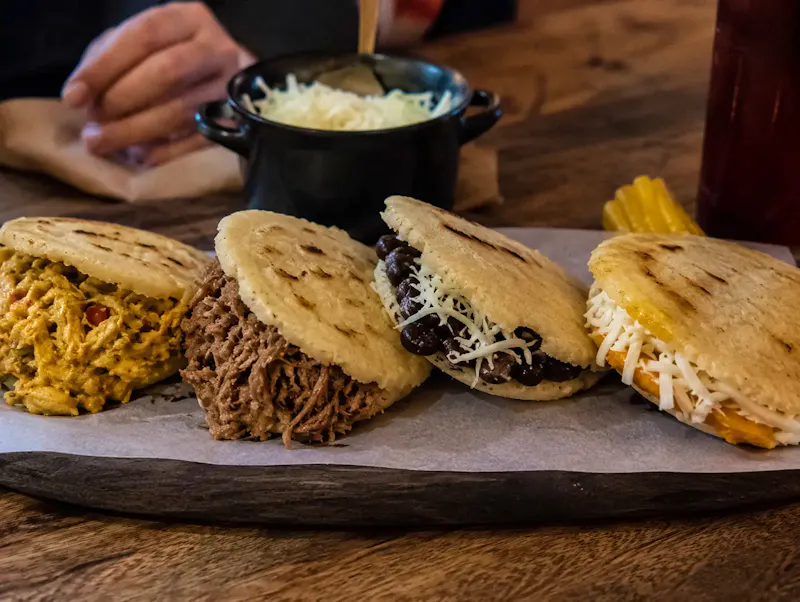
In Venezuela, arepas are often sliced open and stuffed.
They become delicious corn-based sandwiches filled with a variety of ingredients.
Among the most famous are:
Reina Pepiada
Filled with shredded chicken, avocado, and mayonnaise.
Pelúa
Prepared with shredded beef and cheese.
Dominó
A popular combination of black beans and white cheese.
This creativity has greatly contributed to the international popularity of Venezuelan arepas.
Why Have Arepas Become Popular Around the World?
At a time when consumers are increasingly seeking authentic and simple foods, arepas perfectly meet modern expectations.
Naturally gluten-free when prepared traditionally, they can easily adapt to a wide range of dietary preferences.
But their success is rooted above all in their sense of community.
The arepa is a dish that brings people together.
It evokes family meals, traditions passed down from generation to generation, and a strong connection to cultural roots.
Arepas: A Living Heritage
Even today, millions of families prepare arepas daily using methods inherited from their parents and grandparents.
Every recipe tells a story.
Every region adds its own unique touch.
Every bite reminds us that the simplest dishes often carry the richest cultural heritage.
More than just a corn cake, the arepa has become a living symbol of Latin American identity.
And wherever it is enjoyed, it continues to embody the spirit of sharing, generosity, and warmth that defines Latin America.
Discover also
History of corn in Latin America
A sacred food of pre-Columbian civilizations, corn became one of the pillars of Latin American culture and cuisine.History of peruvian Ceviche
Discover the fascinating history of ceviche, an iconic Latin American dish, through ancestral traditions, Peruvian culture, and marine flavors.