
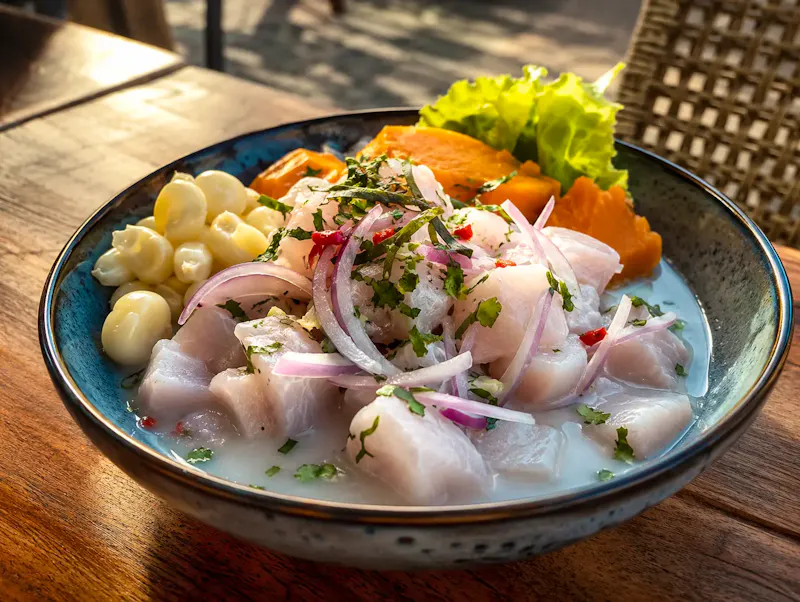
History of peruvian Ceviche
The History of Ceviche: How an Ancient Dish Became a Symbol of Latin American Gastronomy
When people think about Latin American cuisine, certain dishes immediately come to mind: empanadas, tacos, arepas, and of course, ceviche.
Today, ceviche is recognized around the world as one of the most iconic ambassadors of Latin American gastronomy. Found on the menus of both fine dining restaurants and traditional eateries, this fresh and flavorful dish captivates diners with its apparent simplicity. Yet behind every bite lies a fascinating story that dates back thousands of years.
What is Ceviche?
Ceviche is a dish made from fresh fish or seafood marinated in citrus juice, most commonly lime juice. It is usually accompanied by red onions, chili peppers, fresh cilantro, and a variety of side dishes depending on local traditions.
The magic of ceviche lies in a natural process: the acidity of the citrus alters the texture of the fish, giving it an appearance similar to lightly cooked seafood while preserving its freshness.
However, contrary to popular belief, ceviche is far from being a modern invention.
A History That Began Long Before European Arrival
The origins of ceviche can be traced back to pre-Columbian civilizations that inhabited the Pacific coast of South America.
Long before the arrival of Spanish conquistadors, communities living along the coast of present-day Peru were already consuming fresh fish seasoned with local ingredients. Archaeologists estimate that primitive forms of ceviche existed more than 2,000 years ago.
At that time, fish was often marinated using the juice of a local fruit called tumbo or fermented corn beverages such as chicha.
These methods not only enhanced flavor but also helped preserve food in coastal communities where fishing played a central role in daily life.
The Spanish Influence That Transformed the Dish
In the 16th century, the arrival of the Spanish dramatically transformed food traditions across the continent.
Among the ingredients introduced were citrus fruits, particularly lemons and limes. These fruits would revolutionize the preparation of ceviche.
Gradually, traditional marinades were replaced by lime juice, which became the defining ingredient of the dish.
This transformation perfectly illustrates the history of Latin American cuisine: a culinary heritage shaped by encounters, exchanges, and cultural fusion.
Why Is Peru Considered the Birthplace of Ceviche?
Although many variations of ceviche exist throughout Latin America today, Peru is widely recognized as the birthplace of modern ceviche.
The dish occupies such an important place in Peruvian culture that it is considered part of the nation’s culinary heritage. It even has its own official national celebration day.
For Peruvians, ceviche is much more than a recipe—it is a symbol of identity, history, and a deep connection to the Pacific Ocean.
In Lima, often referred to as one of the world's gastronomic capitals, chefs have elevated ceviche into a culinary art form while preserving its traditional roots.
The Different Versions of Ceviche Across Latin America
One of ceviche's greatest strengths is its diversity.
Each country has developed its own interpretation of the dish based on local ingredients, culinary traditions, and cultural influences.
In Peru
Traditional ceviche is made with white fish, lime juice, chili peppers, red onions, and cilantro. It is commonly served with sweet potatoes, giant corn, and toasted corn.
In Ecuador
Ecuadorian ceviche is often served with more marinade and frequently prepared with shrimp. It is commonly accompanied by popcorn or plantain chips.
In Colombia
Along the Caribbean and Pacific coasts, ceviche is often prepared with shrimp, octopus, or local fish varieties. Tropical flavors frequently enrich the recipes.
In Mexico
Mexican ceviche often includes tomatoes, avocado, and spicy elements that give it a unique and vibrant character.
Why Is Ceviche So Popular Today?
In a world where consumers increasingly seek fresh, natural, and authentic food experiences, ceviche perfectly matches modern expectations.
It is perceived as a light, colorful, and flavorful dish deeply connected to the sea.
Beyond its culinary appeal, ceviche tells a story.
Every plate reflects centuries of traditions, coastal communities living in harmony with the ocean, and the cultural exchanges that shaped Latin American gastronomy.
Ceviche: An Invitation to Travel
Tasting ceviche is embarking on a journey through the history of Latin America.
It means discovering the legacy of pre-Columbian civilizations, understanding the impact of cultural encounters, and appreciating the extraordinary diversity of one of the world's richest culinary regions.
Even today, ceviche continues to evolve, inspiring chefs around the globe while remaining faithful to its origins.
Proof that the simplest recipes are often the ones that stand the test of time.
And perhaps that is the true secret of ceviche: a handful of ingredients, generations of knowledge, and a story that continues to be told with every bite.
Discover also
History of arepas : Colombia, Venezuela
Discover the history of arepas, a symbol of Colombia and Venezuela, a millennia-old heritage of corn and Latin American culture.History of corn in Latin America
A sacred food of pre-Columbian civilizations, corn became one of the pillars of Latin American culture and cuisine.